
The Real Law on Roadblocks & Police Searches in Uganda
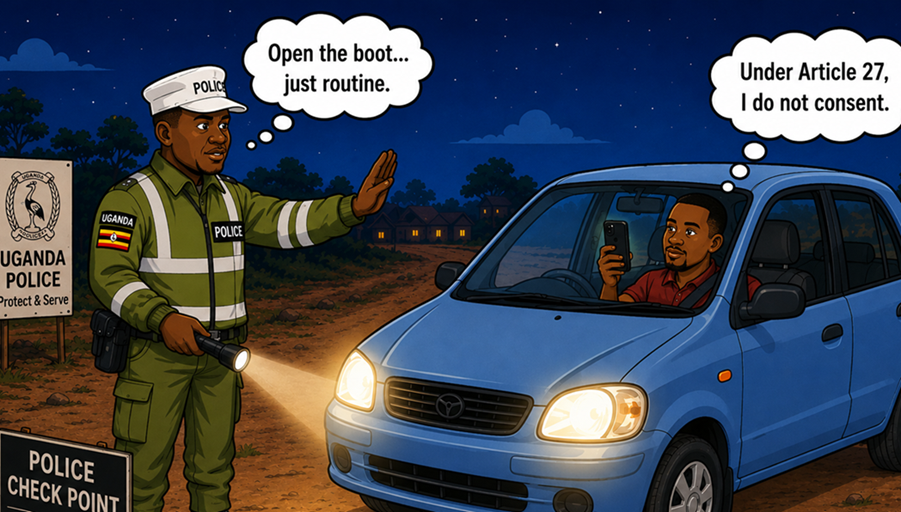
You’re driving home. Music low. Windows down. Life is good. Then you see it. The reflective jacket. The random log across the road.
The officer is waving you down with a torch that hasn’t worked since 2019. Your heart rate spikes. Not because you’ve done anything wrong. But because you know what’s coming next.
“Open the boot.”
“Let me see your phone.”
“You have been drinking?” (At 9am on a Tuesday.)
But here’s the million-shilling question: Does that officer actually have the right to stop you and tear your car apart? Or are we all just trained to say “yes, boss” out of fear?
Let’s cut through the smoke.
The Stop: Yes, They Can Do That
Let’s be fair to the police. Under Uganda’s Traffic and Road Safety Act, 1998, a police officer in uniform can stop any vehicle at any time to check:
- Your driver’s license
- Your insurance (that hard copy they swear doesn’t exist)
- Your logbook
- Whether your lights, tires, or exhaust are trying to kill someone
So the stopping part? Legal. You cannot refuse to stop. If you do? That’s a separate offense.
But here’s where the law and reality start to disagree…
The Search: This Is Where It Gets Sticky
Just because they stopped you does not mean they can search you.
Under Article 27 of the Constitution of Uganda and the Police Act, your car, your bag, and your body are private.
For a police officer to search your vehicle (or you) at a roadblock, they must have one of two things:
- A reasonable suspicion – Not a feeling. Not a vibe. Not “you look rich.” They must point to a specific fact. Example: They smelled actual weed. Or they saw you throw something under the seat.
- A warrant – Yes, a physical search warrant signed by a magistrate. At a roadblock? Almost never happens.
Translation: That officer asking you to “open the boot just to check” because “it’s procedure”? There is no such procedure.
The “Voluntary” Lie
Here’s where police outsmart us (and it’s legal… sort of).
If you say “Okay, fine, search” – you just gave consent. And consent makes the search legal, even without a warrant.
So when they say:
“Nothing to hide? Then open.”
That’s psychological judo. They’ve made you feel guilty for saying no.
You have the right to say: “Officer, I do not consent to a search. If you have reasonable suspicion or a warrant, please proceed.”
Will they like it? No. Will they threaten you? Probably. Is it your right? Absolutely.
What Happens If You Refuse?
This is the part no one tells you.
If you refuse a search and the officer has no reasonable suspicion, you cannot be arrested for refusing.
If you refuse and they search anyway? Anything they find may be inadmissible in court because it was an illegal search.
“But wait – they’ll just plant something.”
Yes. That happens. Which is why you do this: Record everything. Phone in hand. Loudly say: “I am not consenting to this search. I am recording for my safety.”
Most illegal searches end right there.
Quick Cheat Sheet (Save This)
| Situation | Legal? | What you say |
|---|---|---|
| Police stop you | ✅ Yes | Pull over safely. Be polite. |
| Police ask for license/insurance | ✅ Yes | Provide them. |
| Police say “open the boot just to check” | ❌ No (without suspicion) | “I do not consent to a search. Do you have reasonable suspicion?” |
| Police say “we are doing routine checks” | ❌ Not a legal ground | Same as above. |
| Police threaten arrest if you refuse | ⚠️ Intimidation tactic | Stay calm. Say nothing else. Call a lawyer or trusted person. |
The Bottom Line
Most Ugandans comply at roadblocks not because the law says so – but because the consequences of saying “no” feel scarier than the violation of rights. And that’s understandable. No one wants to sleep at the station over a principle. But knowledge is power. You don’t have to be rude. You don’t have to fight. You just have to know: A stop is not a search. And “routine” is not a warrant.
Share this with someone who drives. You might save them from shaking before a bribe… or worse.
Over to you: Have you ever been illegally searched at a roadblock? What happened? Drop it in the comments (anonymously if you want).